
Is that tree safe?
Hazard Tree Assessment in Utica, NY
A close look at the tree and what is under it, with a plain answer: leave it, prune it, watch it or take it down.
- Free on-site estimates
- Written, itemized quote before any cutting
- Cleanup plan agreed up front: chips, logs and brush
Judging a Tree Before It Fails
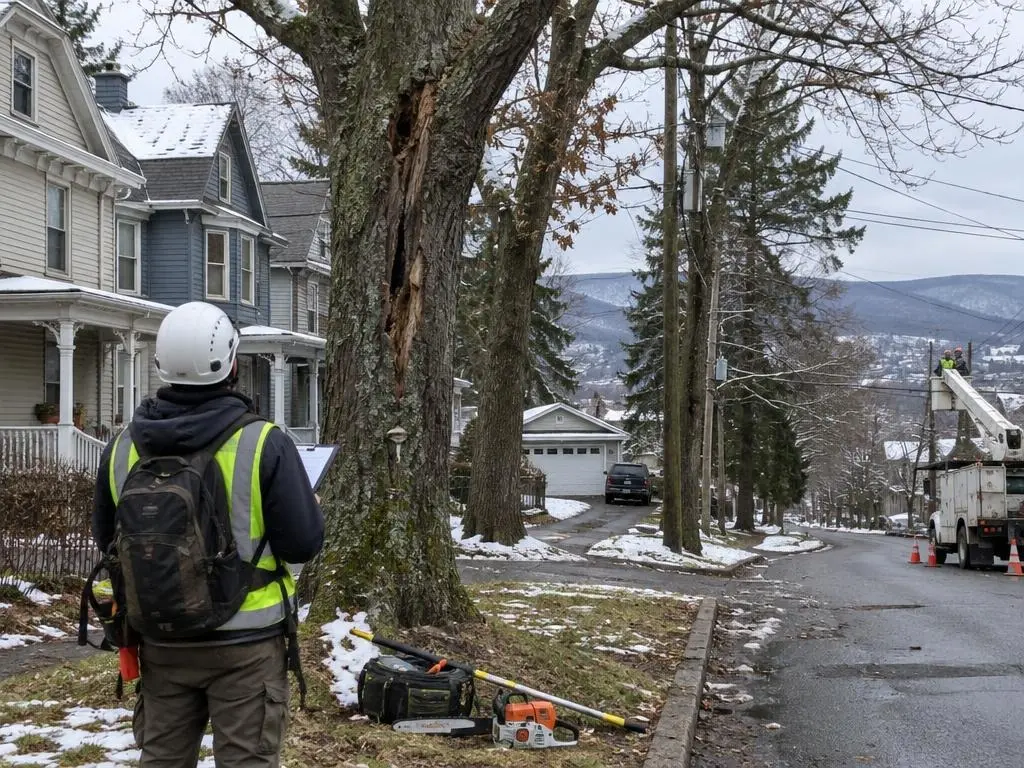
A hazard tree assessment answers a simple question: could this tree, or part of it, fail and hit something that matters? We look at the tree from the roots to the top for defects, and at what lies within reach of it, the house, garage, driveway, a play set, the street. A big tree with a crack over an empty field is a different problem from the same tree over a bedroom.
What we look for
- Decay: cavities, soft or hollow-sounding wood, mushrooms or conks at the base or on the trunk
- Cracks and splits, especially in tight V-shaped forks between two trunks
- Dead branches and dead tops
- A new lean, or soil heaving up on one side of the base
- Root damage from trenching, paving or construction
- Signs of emerald ash borer on ash trees
- Limbs overextended over roofs, wires or the street
Ash trees
Emerald ash borer has been confirmed in every New York county except Hamilton and Lewis, according to the state DEC. Signs to watch for include woodpeckers stripping outer bark so the trunk looks pale, canopy dieback, D-shaped exit holes and S-shaped tunnels under loose bark. Once infested, most ash trees die within two to four years. DEC notes that treatment with insecticide is an option, and that an infested tree only has to come down if it could fall and cause harm. An assessment helps you decide which ash trees are worth treating, which should come down, and which can be left.
Before and after winter
Utica's heavy snow and ice put trees under load for months. Fall is a good time to check trees before that weight arrives; spring is a good time to look for damage the winter left behind, such as cracked forks, hanging limbs and new leans. After any big ice or wind storm, a look at the trees near your house is worth the time.
What you get
We tell you, tree by tree, what we see and what we would do: no action, pruning, cabling or bracing to support a weak fork where it makes sense, monitoring, or removal. If you want the work done, we write it up as an itemized quote. If a tree needs a closer diagnosis, such as testing for internal decay or identifying a disease, we will say so and suggest you have an ISA Certified Arborist look at it.
About credentials
The International Society of Arboriculture (ISA) certifies arborists who meet its experience and exam requirements and keep up with continuing education. You can check whether someone holds the credential on ISA's website. For any tree company, it is also fair to ask for a current certificate of liability insurance and workers' compensation sent directly from the insurer before work starts.
What This Covers
An assessment covers the tree, what it could hit, and what to do next.
Visual tree check
Roots, trunk, forks and crown looked over for decay, cracks and dead wood.
Target review
What lies within reach of the tree: house, driveway, wires, neighbors, the street.
Ash tree check
Ash trees checked for emerald ash borer signs, with treat-or-remove options.
Written recommendations
Tree by tree: leave, prune, watch or remove, with an itemized quote if wanted.
Typical Tree Assessment Costs
| Item | Published range |
|---|---|
| Tree inspection or risk assessment (HomeGuide) | $100 to $250 |
| Single-tree consultation and report (HomeGuide) | $150 to $450 |
| Multiple-tree consultation and report (HomeGuide) | $300 to $700 |
| Certified arborist, hourly (HomeGuide) | $100 to $250 |
| Arborist report for a permit, average (Angi) | about $860 |
National ranges from HomeGuide's arborist cost guide (2026) and Angi (2026). Our walk-around look during a free estimate is not a formal written arborist report; if you need one for a permit, insurer or legal matter, we will tell you. Your written estimate is the price.
How It Works
1. Tell us what worries you
A crack, a lean, dead branches, an ash tree, or storm damage.
2. Walk the trees
We check each tree and what it could hit if it failed.
3. Plain answer
Leave, prune, support, watch or remove, tree by tree.
4. Quote if needed
Any recommended work written up and priced before anything is cut.
Hazard Tree Assessment Questions
How do I know if a tree is dangerous?
Warning signs include mushrooms or conks at the base, cavities, deep cracks, a split fork, a dead top, a new lean with soil lifting on one side, and branches with no leaves in summer. Any of those near a house, driveway or the street is worth having looked at.
Can a tree with a hollow trunk be saved?
Sometimes. A tree can stand with some internal decay if enough sound wood remains around it. How much is enough depends on the tree, its size and what it would hit. If it is close, we will suggest a closer look by an ISA Certified Arborist.
Should I treat or remove my ash tree?
It depends on the tree's condition and where it stands. New York State DEC lists insecticide treatment as an option and says removal is only needed when an infested tree could fall and cause harm. A healthy, valuable ash may be worth treating; one already in heavy decline near the house usually is not.
What is an ISA Certified Arborist?
A tree care professional who has met the International Society of Arboriculture's experience and exam requirements and keeps up continuing education. You can verify the credential on ISA's website. It is worth asking about when a job involves diagnosing disease or judging a tree's safety.
Hazard Tree Assessment Service Areas
- Tree Service in Utica, NY
- Tree Service in New Hartford, NY
- Tree Service in Whitesboro, NY
- Tree Service in Yorkville, NY
- Tree Service in New York Mills, NY
- Tree Service in Clinton, NY
- Tree Service in Rome, NY
- Tree Service in Oriskany, NY
- Tree Service in Marcy, NY
- Tree Service in Deerfield, NY
- Tree Service in Frankfort, NY
- Tree Service in Ilion, NY
- Tree Service in Herkimer, NY
- Tree Service in Mohawk, NY
- Tree Service in Little Falls, NY
- Tree Service in Waterville, NY
- Tree Service in Sauquoit, NY
- Tree Service in Remsen, NY
- Tree Service in Boonville, NY
- Tree Service in Holland Patent, NY
- Tree Service in Oneida, NY
- Tree Service in Sherrill, NY
Get a Hazard Tree Assessment Estimate
Free estimates and tree checks.